
- run a Recipe that finds patients whose birthday is today
- send those patients a birthday Email Template
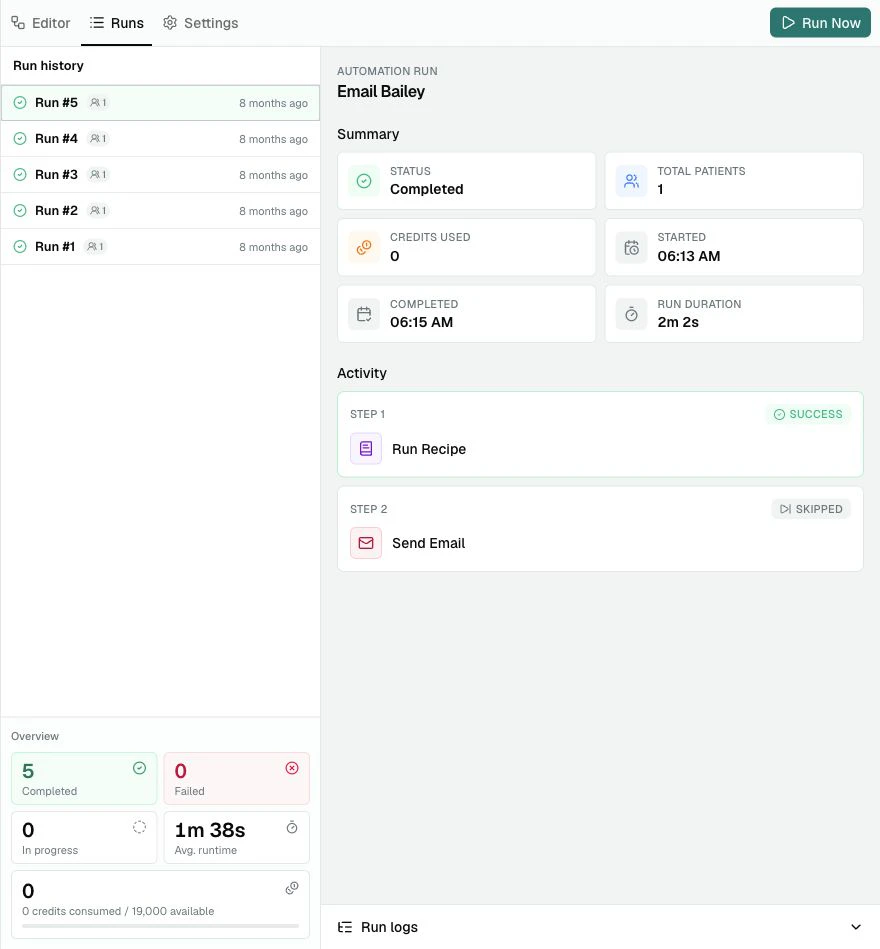
- keep a record of each Automation Run
- avoid sending to patients who cannot be contacted or have opted out
Automations are designed to support practice workflows. Review the Recipe,
Template, timing, limits, and any Clinical Review needs before using an
Automation with patients.
Open Automations
Open Automations from the sidebar. The Automations page shows your saved Automations, including the number of Runs, current status, next scheduled run, last run, and row actions.
- search Automations
- open an Automation
- create a new Automation
- run an existing Automation manually
- delete an Automation when it is no longer needed
How Automations are built
The editor is arranged in the same order the workflow runs. Automation details name and describe the Automation for your team. Run uses When to choose how the Automation starts. Its settings also choose the Patient Cohort: Manual and scheduled Automations use a Recipe, while an event Automation uses the Patient affected by the event. Do this contains the ordered Automation Steps, such as sending an Email, sending an SMS, creating a Report, waiting, or asking for Clinical Review.Choose when it runs
Choose I trigger this manually when your practice wants to start each Automation Run itself. Manual Automations are useful while setting up, testing, or keeping a workflow under close team control. Choose On a recurring schedule when the Automation should run automatically at a regular time, such as every morning or every Monday.Active and Inactive Automations
An Active Automation has automatic triggers enabled. An Inactive Automation does not have automatic triggers enabled, but it can still be edited and run manually. A Manual Automation appears Inactive because there is no schedule for PracticeMate to run automatically. A Scheduled Automation can be Active when its automatic schedule is enabled.Automation Runs
An Automation Run is one execution of an Automation. Runs can be:- Manual Automation Runs, started by a Member using Run Now
- Scheduled Automation Runs, started by a saved Schedule
Version locks
When you save an Automation, PracticeMate locks in the current Recipe Version and Template Version selected in the editor. This means later edits to that Recipe or Template do not quietly change an Automation your team has already prepared. If a selected Recipe or Template changes later, the Automation can show that it is using an older version. You can review the change and choose Update to latest when you want the Automation to use the newest saved version.Version locks are there to protect saved workflows. They help make sure an
Automation keeps using the Recipe and Template content your team selected,
until someone deliberately updates it.
A reliable way to build
1
Prepare the Recipe
Check that the Recipe finds the right Patient Cohort. Test it before using
it in an Automation.
2
Prepare the Template
Review and test the Email or SMS Template. Make sure Template Variables,
links, and wording are appropriate.
3
Create the Automation manually first
Use Manual while building, so the Automation only runs when your team
chooses Run Now.
4
Choose the Recipe
Under Run, select the Recipe the Automation should use.
5
Add the steps
In Do this, add the actions in the order they should happen.
6
Save and review
Save the Automation, then check the Runs and Settings tabs before
running it with patients.
7
Schedule when ready
If the workflow should run automatically, set When to On a recurring
schedule, choose the timing, and save.