
Documentation Index

Fetch the complete documentation index at: https://docs.practicemate.com.au/llms.txt

Use this file to discover all available pages before exploring further.

In this guide, you will build a simple Email Template for: A birthday message from your practice. It is a gentle example, but it introduces the main parts of the Email Template editor: the Template name, fixed subject line, preview text, body content, Template Variables, Preview, Test, and Save.

Before you start

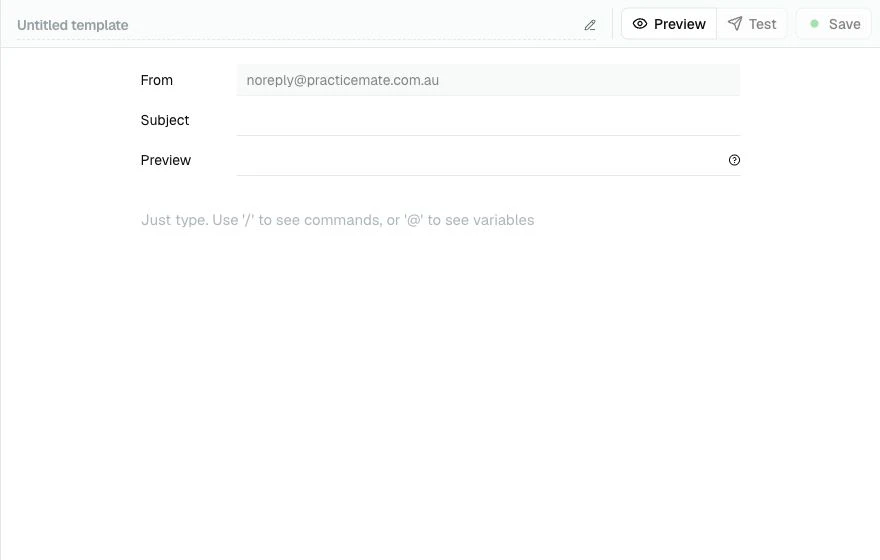
In the sidebar, under Comms, select Templates. Select New Email Template. PracticeMate opens a blank Email Template editor. A blank new Email Template editor showing the Template title, From address, Subject, Preview, body area, Preview, Test, and Save buttons.
Name the Template

Select the title at the top of the page and enter: Birthday Email The name is for your practice team. Patients do not see it.
Use a name your team will recognise later. Birthday Email is clearer than Email 1 or Test birthday.

Add the Email details

The Email editor has three fields above the body. From is fixed as noreply@practicemate.com.au. Subject is the line patients see in their inbox. Preview is the short snippet many inboxes show beside or under the subject. For this guide, use:
  • Subject: Happy birthday from your practice
  • Preview: A short birthday message from your practice team.
Email subject lines and preview text are fixed plain text. Do not use Template Variables in these two fields. Add Template Variables in the Email body instead.

Write the greeting

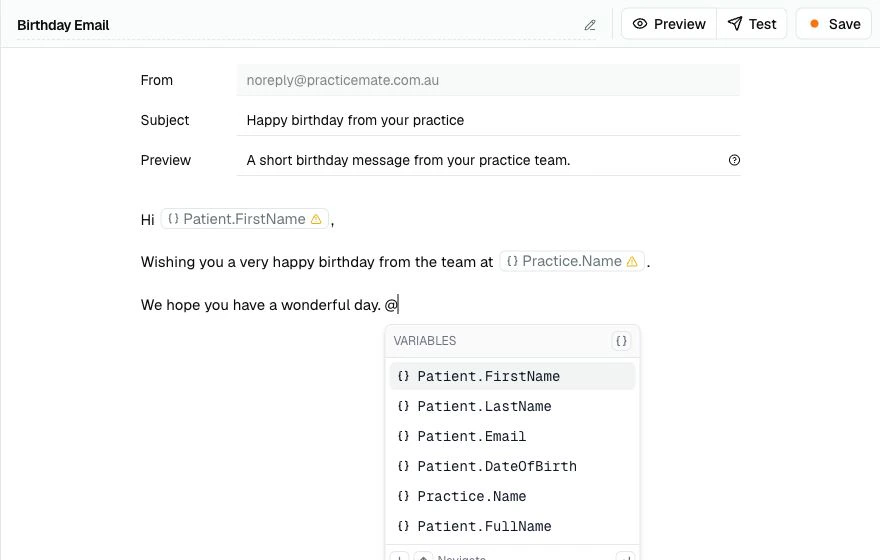
Click into the body area and start with: Hi Then type @ to open the Template Variable menu. Choose Patient.FirstName. The Email Template body with the Template Variable menu open, showing Patient.FirstName, Patient.LastName, Patient.Email, Patient.DateOfBirth, Practice.Name, and Patient.FullName. This inserts a variable pill into the message. When the Email is sent, PracticeMate replaces it with the patient’s first name. Continue the message:
Wishing you a very happy birthday from the team at Practice.Name.
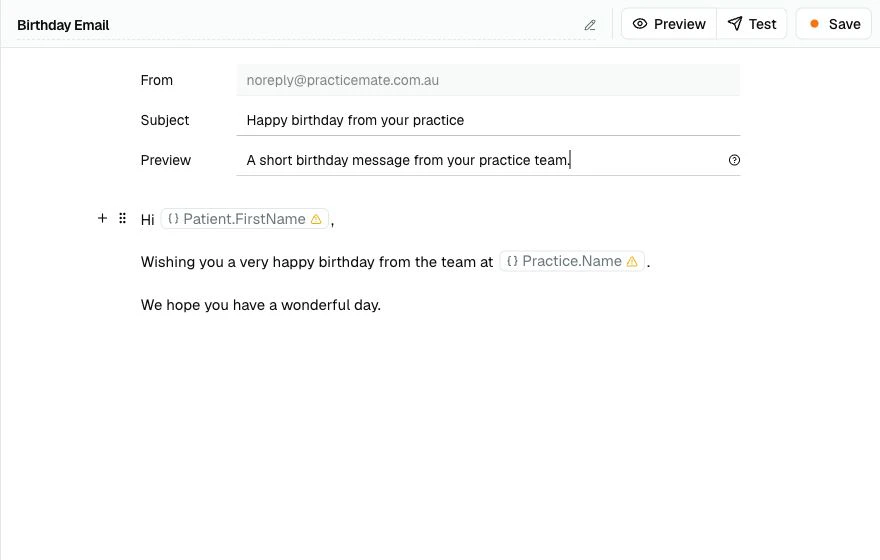
Insert Practice.Name with the same @ menu. The Email Template editor showing a birthday Email body with Patient.FirstName and Practice.Name Template Variables inserted.
Add more structure if needed

For a simple Email, plain paragraphs are enough. If you want to add headings, lists, images, buttons, sections, dividers, or reusable Template Components, type / on a blank line. For this first Template, keep the Email short and easy to read.
A birthday Email does not need much. A warm greeting, one short message, and a sign-off is usually enough.

Compare with the example Birthday Email

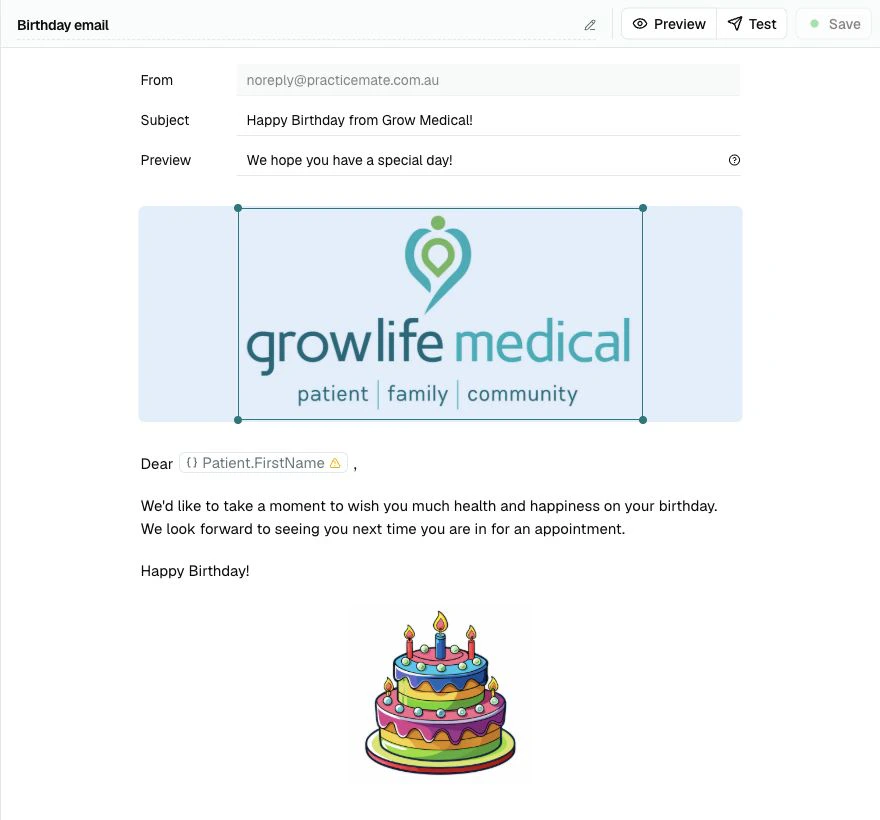
Your practice may already have a Birthday email Template. It shows the same idea with a logo, body copy, image, and sign-off. The Birthday email Template open in the Email Template editor, with subject, preview text, logo, Patient.FirstName variable, birthday copy, image, and sign-off.
Preview the Email

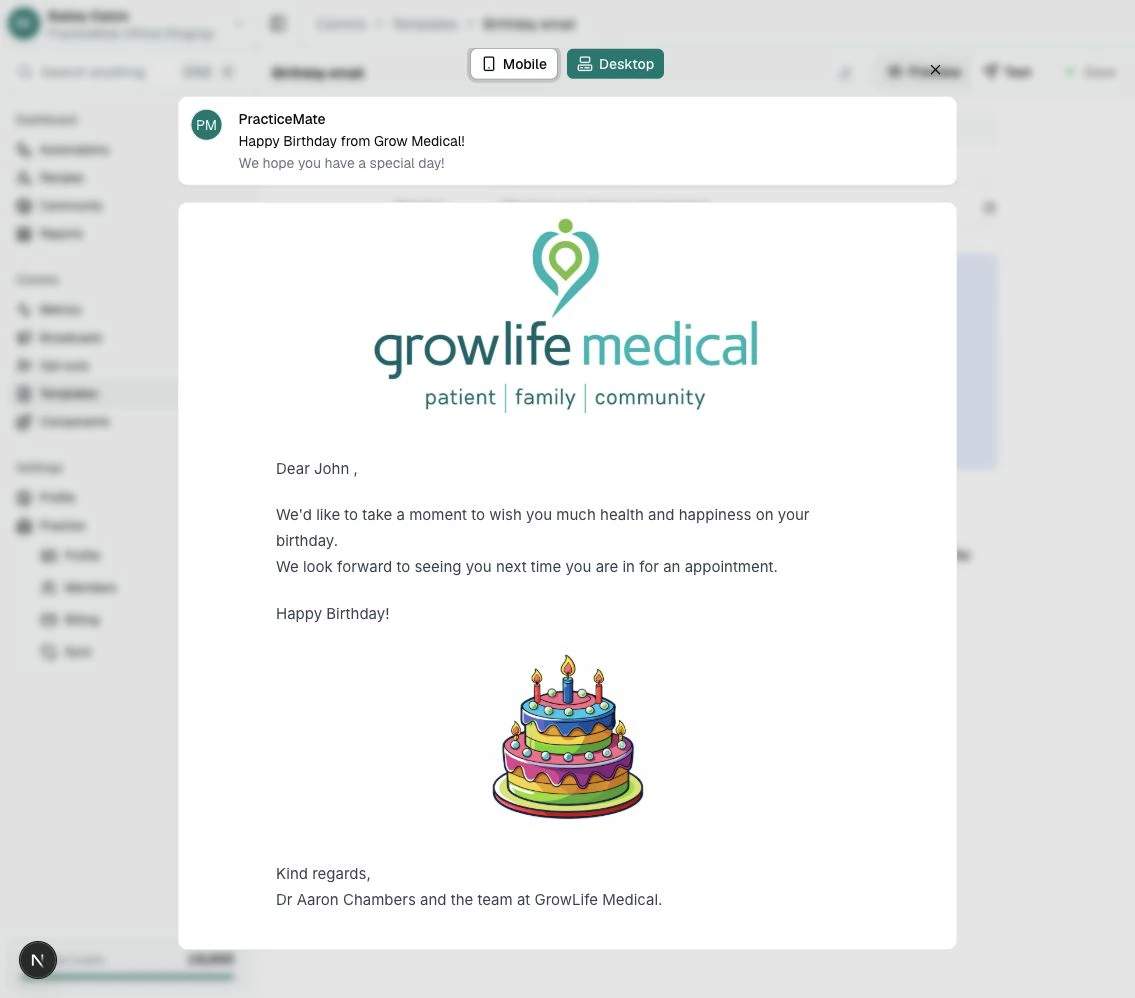
Select Save first, then select Preview. Preview shows the saved Email as a patient might see it, including the inbox-style subject and preview text. You can switch between Mobile and Desktop. The Email Preview dialog showing Mobile and Desktop options, the inbox-style subject and preview text, and the rendered Email body. Preview renders the saved Template. If you have made changes, save before previewing so the Preview matches your latest draft.
Send a test Email

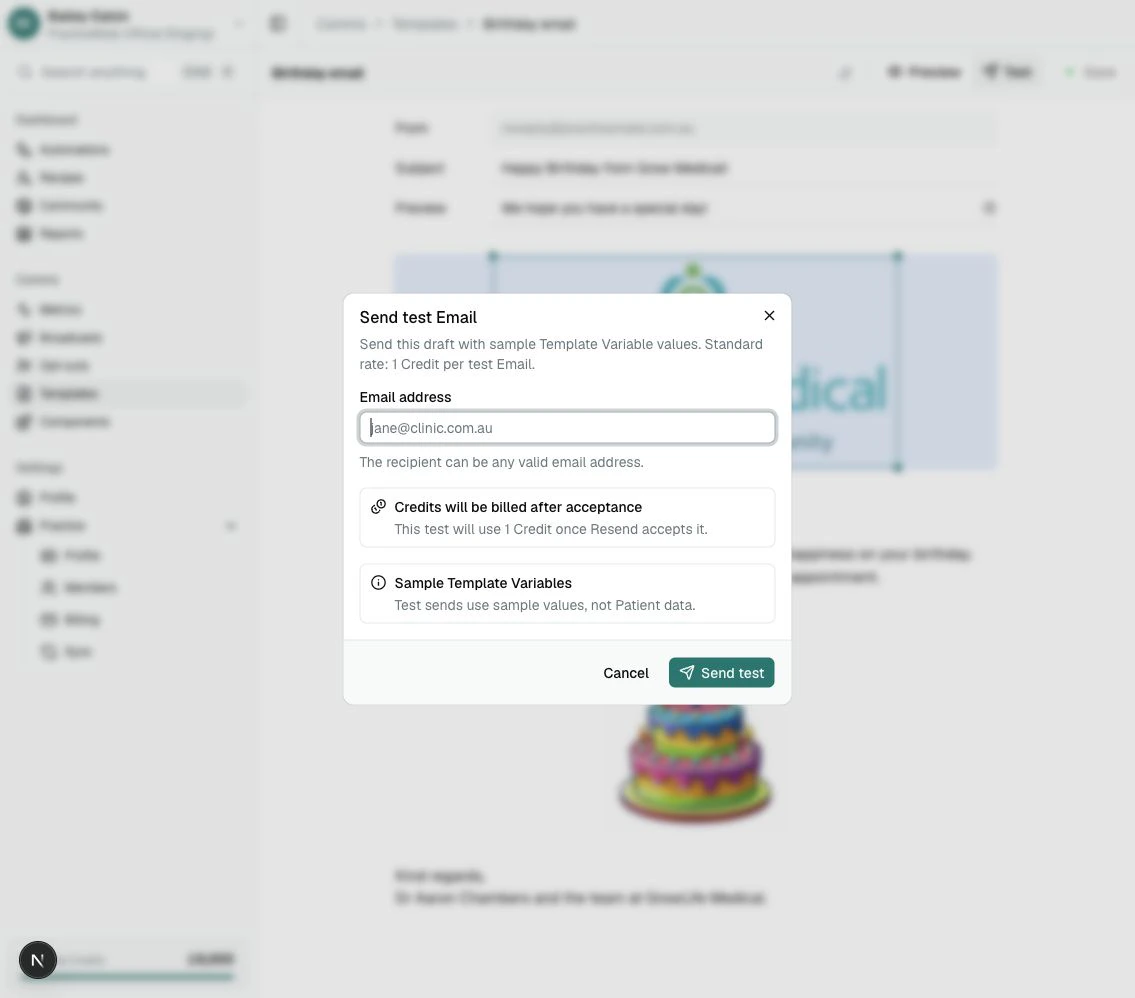
Select Test. Enter an Email address for yourself or another team member, then send the test. The Send test Email dialog showing the Email address field, Credit notice, sample Template Variable notice, Cancel button, and Send test button. Test Emails use sample Template Variable values. They are helpful for checking the wording, layout, subject, preview text, and links before sending to patients. A test Email uses 1 Credit.
Save the Template

When the Template reads well and the test looks right, select Save.
You have built your first PracticeMate Email Template.
Saving creates the first version of the Email Template. If you edit and save the Template again later, PracticeMate adds another version to its Version history. Open Version history from the menu on a Template card. It lets you preview earlier saved wording and restore it if your practice needs to return to it.

What you learned

You used:
  • a clear Template name
  • a fixed subject line
  • fixed preview text
  • Email body copy
  • the @ menu for Template Variables
  • the / menu for Email blocks
  • Preview
  • Test
  • Save
  • Version history as a way to return to earlier saved wording
Next, create your first SMS Template.