
- Which active patients are due for a review?
- Which patients match a recall or quality improvement cohort?
- Which patients have had several visits recently?
- Which patients have a result, prescription, condition, reminder, or appointment pattern worth reviewing?
Recipes are designed to support practice workflows. They do not make clinical
decisions by themselves. Always review the results in the context of the
patient’s record and your practice’s usual process.
How Recipes are built
Most Recipes have two parts. Patient filters describe the patient group you are starting with. For example:- Status is Active
- Extraction Opt-Out is False
- Age (Years) is greater than or equal to 50
- Sex is Male
- has any Prescriptions where Product Name contains statin
- has no Appointments where Appointment Date is after today
- has a count of at least 3 Visits where Visit Date is in the last 2 years
Default filters
New Recipes start with two filters already in place:- Status is Active
- Extraction Opt-Out is False
Version history
Each time you save a Recipe, PracticeMate keeps that saved version. This makes it easier to review what changed and return to an earlier version if a Recipe no longer looks right. Open Recipes, select the … menu beside a Recipe, then choose Version history.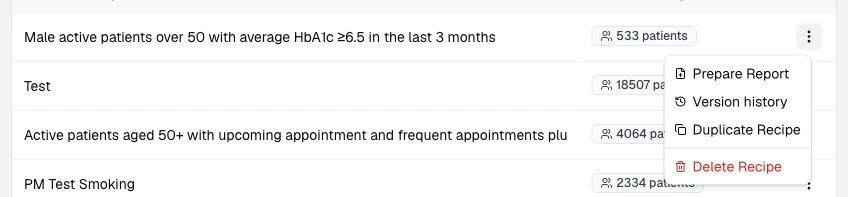
- browse earlier saved versions
- see which version is current
- preview an older Recipe before changing anything
- restore an older version when your practice wants to go back to it
When a Recipe is already used in a Broadcast or Automation, PracticeMate keeps
that saved workflow connected to the version it was set up with. This helps
prevent later edits from quietly changing work your team has already prepared.
A reliable way to build
1
Say the patient group in plain English
For example: “Active male patients aged 50 or older.”
2
Turn each part into one filter
“Male” becomes Sex is Male. “50 or older” becomes Age (Years) is
greater than or equal to 50.
3
Test before saving
Use Test to check whether the number of matching patients looks right
before you save or use the Recipe elsewhere.
4
Name it clearly
A good name makes the Recipe easier to find later. Use names like “Active
male patients aged 50+” rather than “Test recipe”.
5
Save when the Recipe is ready
Saving creates a new version, so your practice has a point to return to if
the Recipe changes later.